Niseko Chalets: What It Actually Takes to Book the Powder Season
The powder-season calendar, what a serviced chalet really includes, Hirafu against the quieter villages, and how the desk actually gets you a house in January.
A luxury Niseko chalet is booked by conversation rather than by checkout: you send your dates, your numbers and the village you would like to be in, and a named concierge comes back with a shortlist of specific houses, the real rate for those exact nights, and a hold on the one you want. On our Niseko list the from-rates run from $560 a night at Kita Kitsune Chalet, a four-bedroom, up through Momiji Lodge at $613, Aoyama Lodge at $621 and Mizunara Chalet at $657, to Sekka Ni at $793 for the whole villa and Shousugi Chalet at $890. Those are starting rates, and January is where they stop applying.
The Niseko year is really one long argument about January. The snow that made the place famous arrives on a Siberian wind and settles through the deep midwinter, which is why January and February are the peak — and the weeks that book furthest ahead in the whole Niseko calendar. If you are reading this in August about the coming January, treat it as a question of what is still free rather than what is ideal, and ask early. December and late March are the quieter, cheaper end of the same mountain, and for families learning to ski they are often the better trade.
The word chalet covers two quite different holidays in Niseko, and the difference matters more than the bedroom count. A serviced chalet comes with people — the shape varies house to house, but it commonly means a daily housekeeper, breakfast laid before the first lift, a driver for the short hop to the gondola, and someone who books your ramen table and sorts your passes. A self-catered chalet gives you the same architecture and a kitchen, and leaves the rest to you: cheaper per night, and genuinely better if your group cooks and likes the house empty. Listings rarely make the distinction legible, so ask the desk which houses on your shortlist come staffed, and what staffed means in each one.
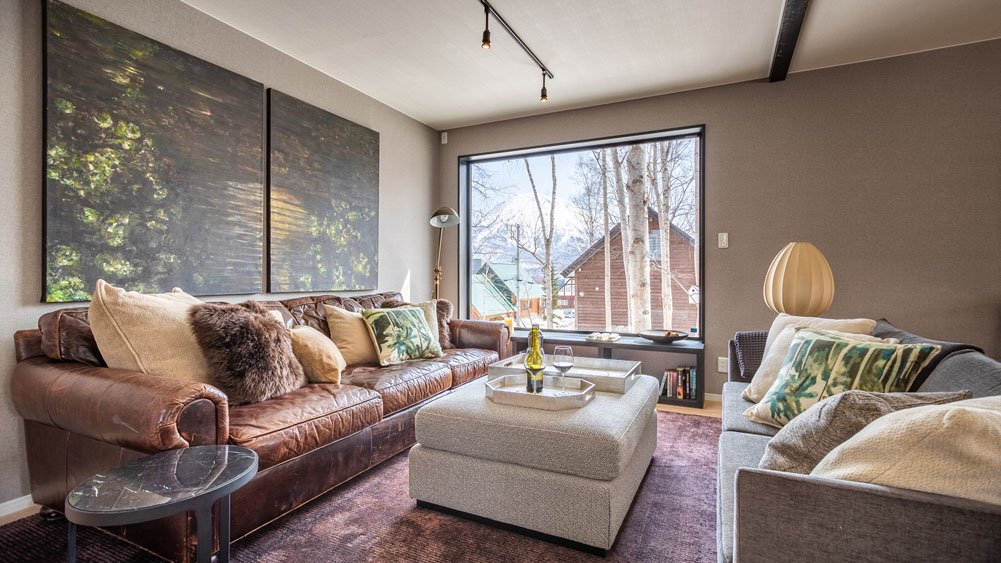
Hirafu is the town — the densest run of restaurants, bars, ski hire and convenience stores in Niseko, walkable at night in ski boots and loud in the good sense through February. It is the right base for a group that wants to eat somewhere different every evening and walk home. The quieter bases around the same linked mountain, and the chalets set back in the woods above the village roads, trade that for silence, snow sitting on the trees outside the window and a five-minute drive to dinner. Families with small children, and groups who came for the skiing rather than the après, tend to be happier out there; first-timers usually want Hirafu.
Almost everyone arrives through New Chitose, Hokkaido's main airport, south-east of Sapporo, with connections from Tokyo running through the day and further seasonal services in winter. From the terminal it is a road transfer of a couple of hours or so to the Niseko villages, longer in weather, and the transfer is the part people underestimate: a private car with child seats and a ski rack, booked in advance, is worth considerably more at eleven at night in a snowstorm than it costs. Your concierge arranges it alongside the chalet rather than leaving it to you at arrivals with four sets of skis.
Almost everything on our Niseko list is a four-bedroom house — Kita Kitsune at $560, Momiji Lodge at $613, Aoyama Lodge at $621, Mizunara at $657 and Shousugi at $890 — which is roughly the size the mountain is built around: one family travelling with grandparents, or four couples, or a ski group that wants a boot room, a drying cupboard and one long table to eat at. Sekka Ni is taken as a whole villa at $793. Beyond that, the honest answer for a party of twelve or more is usually two chalets a short walk apart rather than one enormous one, and the concierge's job is to find two that are genuinely adjacent and free on the same nights.
The booking itself is unglamorous and quick. You send dates, numbers, village and rough budget by WhatsApp, form or email; a named concierge builds the offer list; they check the real seasonal rate with each house — powder-season rates sit well above the from-price — and confirm availability; they hold your first choice while you decide. A deposit, typically fifty per cent, confirms it, and the balance is settled before arrival. You pay the villa's own rate throughout: the concierge is paid by the property, so nothing is added on top for the introduction, the transfer, or the chef and lift-pass conversations that follow.
What makes a Niseko enquiry easy to answer is specificity. Give exact nights rather than mid-January, the real number of adults and children and the children's ages, whether you want to walk to dinner or drive to it, and whether you would rather be cooked for or left alone with a good kitchen. Say what you are prepared to pay a night, and whether that number is firm. With all of that, a shortlist of real houses comes back quickly, with rates that will still be true when you book. Without it, what you get is a search page — which is what you were already looking at.
January in Niseko is not really a booking, it is a queue. The powder weeks go long before the first snow falls.
Send us your dates, your numbers and the kind of week you have in mind, and a concierge will come back with a short list of real Niseko houses and the true rate for those exact nights.
Good to know
How far in advance should I book a Niseko chalet?
Book January and February as far ahead as you can. Those are the peak powder weeks and they go first, well before the season opens, so the best houses are held months in advance. December and late March are far easier and usually cheaper. If your dates fall inside the peak, send them anyway — the desk can check the houses directly and tell you quickly what is genuinely still free, rather than leaving you to guess from a search page.
How much does a luxury chalet in Niseko cost per night?
On our Niseko list, from-rates start at $560 a night for Kita Kitsune Chalet and run through Momiji Lodge at $613, Aoyama Lodge at $621, Mizunara Chalet at $657, Sekka Ni at $793 for the whole villa, and Shousugi Chalet at $890. Those are starting prices for the quieter weeks; January and February, the powder-season peak, sit above them. A concierge quotes the real rate for your exact dates before you commit to anything.
What is the difference between a serviced and a self-catered Niseko chalet?
A serviced chalet comes with staff — commonly daily housekeeping, breakfast before the first lift, a driver for the run to the gondola, and someone handling restaurant tables and lift passes. A self-catered chalet gives you the same house and a kitchen, and nothing else. Self-catered costs less and suits groups who cook and want privacy. The arrangement varies house to house, so ask which of your shortlisted chalets are staffed and exactly what that covers.
Should I stay in Hirafu or one of the quieter Niseko villages?
Hirafu has the restaurants, bars, ski hire and shops, and you can walk between them at night in ski boots — it suits groups who want somewhere different to eat every evening, and first-timers who like being in the middle of things. The quieter bases on the same linked mountain give you silence, snow-heavy trees and a short drive to dinner instead. Families with young children and groups who came mainly to ski usually prefer the quiet side.
How do I get to Niseko from New Chitose Airport?
New Chitose, south-east of Sapporo, is where almost everyone arrives, with connections from Tokyo through the day and further seasonal services in winter. From the terminal it is a couple of hours or so by road to the Niseko villages, longer in heavy weather. Book a private transfer in advance, with child seats and a ski rack if you need them; your concierge arranges it alongside the chalet so nobody is negotiating at arrivals with four sets of skis.
What size chalet do I need for a family or a ski group?
Most of the Niseko houses we book are four-bedroom chalets — Kita Kitsune, Momiji Lodge, Aoyama Lodge, Mizunara and Shousugi — which suits one family travelling with grandparents, four couples, or a ski group that wants a boot room, a drying cupboard and one long table. Sekka Ni is taken as a whole villa. For a party of twelve or more, two chalets a short walk apart usually works better than one very large house.

