Estate, Villa or Compound? What You’re Actually Renting
Three words that listings use loosely and guests read literally: what each one means on the ground in Bali and Thailand, which properties are let whole and which in parts, and why a group usually wants an estate.
The words on a listing do more work than they appear to. Villa, estate and compound are not regulated terms anywhere in the region: a two-bedroom house can call itself an estate, and a twelve-bedroom property can call itself a villa. Yet the difference decides what you are paying for: whether you have the whole of a property or part of one, whether the staff are yours, and whether the people at the next pool are your group or someone else’s. Here is how we use the three words, and how to read them when someone else is using them.
A villa, in the sense the trade uses it in Bali and Thailand, is a single private house taken whole: its own gate, its own pool and its own staff for the length of the stay. Size runs from one bedroom to eight or more. What defines it is not luxury or scale but exclusivity, and the test is simple. Ask whether any part of the property, the pool, the garden or the kitchen, is shared with other guests. In a villa, the answer is no.
An estate is a larger property on its own grounds, usually with more than one building, run by a resident team and usually let as a whole. Sometimes it is a single house spread across several pavilions; sometimes it is a cluster of separate villas behind one gate, which can be taken one at a time or together. What makes it an estate rather than a big villa is the land and the running of it: a garden or lawn that the buildings arrange themselves around, and a staff large enough to run the place as one household, from the manager and the housekeepers to the gardeners and, often, a cook.
A compound is the loosest of the three. In Bali the word comes from the family compound, several pavilions inside one wall, and on rental listings it usually means several dwellings sharing a perimeter, taken together or let unit by unit to different guests. That second case is the one to check. A compound let in parts is closer to a small hotel than to a private house: often lovely, often good value, but not yours alone. If a listing does not say whether the whole compound is reserved for your group, ask.
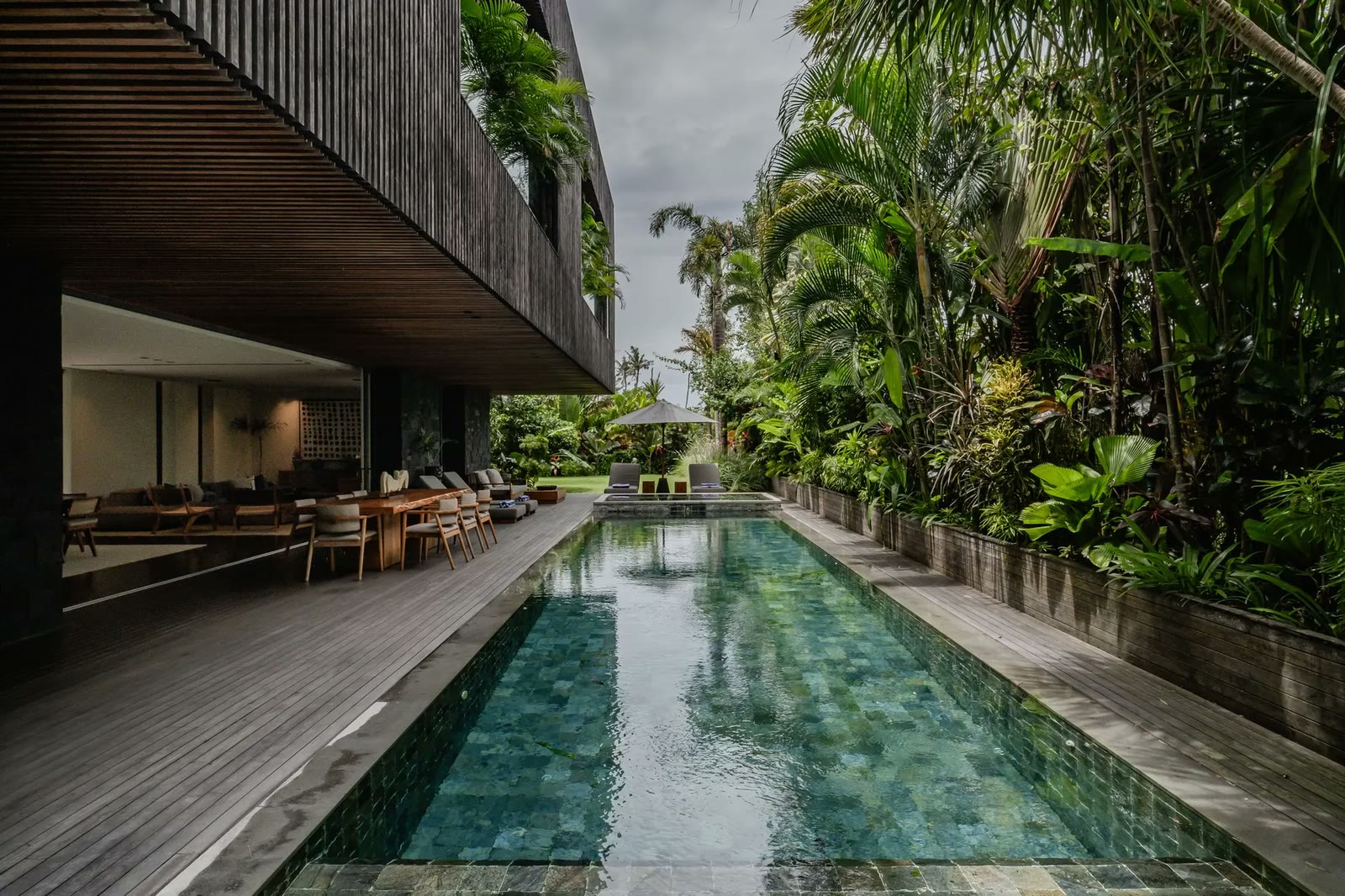
Ocean Palm Estate in Pererenan, on Canggu’s quieter western edge, is the clearest example we have of an estate booked whole. It is one property: seven bedrooms, each with its own bathroom and terrace, a central garden, living pavilions that open onto the deck, one long table, and a jade-tiled lap pool with a jetted spa pool one step above it. The estate staff are there daily, a private chef cooks on request with meals charged separately, and the beach is about five minutes away by car. Nothing is shared: one booking takes the whole estate, for up to fourteen guests.
Other estates on our books are several villas behind one gate. Shalimar Estate in Seseh is three separate beachfront villas, Villa Cantik with two bedrooms, Villa Makanda with four and Villa Kalima with six, run by one team of villa managers, chefs, housekeepers, gardeners and security, and bookable one at a time or together as twelve bedrooms. Sohamsa Ocean Estate, on the southern Bukit, pairs two five-bedroom villas, Villa Soham and Villa Hamsa. On the cliffs at Ungasan, The Surga Villa Estate holds Surga One, with six bedrooms, and Surga Two, with seven; taken together it is thirteen bedrooms for twenty-six.
Then there is the estate let in more than one shape. Uluwatu Estate, above Nyang Nyang beach on the Bukit and one of Mandarin Oriental’s Exceptional Homes, is offered either as the full eight bedrooms for sixteen or as a four-bedroom configuration for eight. Both are the same property, and the smaller configuration is let on an exclusive-occupancy basis, so a party of eight still has the estate to itself. Daily breakfast and a dedicated chef are included there, with other food and drink charged on consumption, a reminder that what an estate includes is set house by house, never by the word on the listing.
Thailand uses the same words in the same loose way. The Jivana Beach Villas estate on Natai Beach, in Phang Nga just north of Phuket, is two six-bedroom beachfront villas and one of seven bedrooms, Villa Jia, Villa Shanti and Villa Ananda, and each is let on its own. On Koh Samui, Inasia Beach Villa at Lipa Noi is a beachfront complex of two independent villas, which a family can split between generations without leaving the property.
Why do groups end up in estates? Because the arithmetic of a group is not only bedrooms. Fourteen people need somewhere to be together and somewhere to be apart, a long table and a quiet terrace, and a team that can feed and look after them without anyone having to organise it. An estate gives you both: separate buildings or wings for sleeping, shared spaces for the day, and a staff that runs the place as one household. It also simplifies the booking: one gate, one calendar, one set of terms and one person to call.
When you read a listing, five questions settle what you are actually renting. Is the whole property reserved for your group, or part of it? How many bedrooms have their own bathroom? Which spaces, if any, are shared with other guests? Which staff come with the stay, and which services, from a cook to breakfast to a driver, are included or charged separately? And what do the house rules say about numbers and noise? An honest listing answers all five; where it does not, the desk will.
For the larger Bali houses that take a group under one roof, see the large-group villas on The Luxury Bali, our sister site for Bali.
A villa is a house you have to yourself. An estate is a place you have to yourselves.
The estate’s own site. Ocean Palm Estate keeps its own website, with the story of the house, its rooms and the full gallery: ocean-palm.com.
Tell the concierge how many of you there are and how you like to spend a day together, and we will tell you whether you want a villa, an estate or two houses side by side, and which are free for your dates.
Good to know
What is the difference between a villa and an estate?
A villa is a single private house taken whole, with its own pool and staff. An estate is a larger property on its own grounds, either one house spread across several pavilions or several villas behind one gate, run by a resident team and usually let as a whole. Neither word is regulated, so read the listing for what is actually reserved for you.
What is a villa compound?
Several dwellings inside one wall, as in a traditional Balinese family compound. In rentals the important question is whether the whole compound is reserved for your group or let unit by unit to different guests; if it is let in parts, you will share the grounds.
Is Ocean Palm booked as a whole estate?
Yes. Ocean Palm Estate in Pererenan is one property, booked whole by a single group of up to fourteen: seven bedrooms, each with its own bathroom and terrace, a central garden and a jade-tiled lap pool with a jetted spa pool, with the estate staff there daily.
Can you book one villa of a multi-villa estate?
Often, yes. On Shalimar Estate in Seseh and the Jivana Beach Villas estate on Natai Beach, each villa has its own listing and can be let on its own, or several can be taken together for a larger group. Other estates come in more than one size instead: Uluwatu Estate is let as eight bedrooms, or as four on an exclusive-occupancy basis, so even the smaller party has the estate to itself.
Why do large groups choose estates?
Because a group needs space to be together and space to be apart, and a team to run it. An estate’s separate buildings or wings, shared living spaces and resident staff give fourteen people a long table and a quiet terrace, with one booking, one calendar and one set of terms.


